Big O Review
Big O Review
What's the best way?

Previously...
Print all integer solutions to:
$a^3 + b^3 = c^3 + d^3$
for $a$, $b$, $c$, and $d$ between $1$ and $n$.
Source: Cracking the Coding Interview, p.68
$a^3 + b^3 = c^3 + d^3$
def print_solutions(n):
    for a in range(1, n+1):
        for b in range(1, n+1):
            for c in range(1, n+1):
                for d in range(1, n+1):
                    if a**3 + b**3 == c**3 + d**3:
                        print(a, b, c, d)
def print_solutions(n):
    for a in range(1, n+1):
        for b in range(1, n+1):
            for c in range(1, n+1):
                for d in range(1, n+1):
                    if a**3 + b**3 == c**3 + d**3:
                        O(1)
def print_solutions(n):
    for a in range(1, n+1):
        for b in range(1, n+1):
            for c in range(1, n+1):
                for d in range(1, n+1):
                    O(1)
def print_solutions(n):
    for a in range(1, n+1):
        for b in range(1, n+1):
            for c in range(1, n+1):
                O(n)
def print_solutions(n):
    for a in range(1, n+1):
        for b in range(1, n+1):
            O(n²)
def print_solutions(n):
    for a in range(1, n+1):
        O(n³)
def print_solutions(n):
    O(n⁴)
$a^3 + b^3 = c^3 + d^3$
Can we do better?
def print_solutions(n):
    for a in range(1, n+1):
        for b in range(1, n+1):
            for c in range(1, n+1):
                for d in range(1, n+1):
                    if a**3 + b**3 == c**3 + d**3:
                        print(a, b, c, d)
def print_solutions(n):
    for a in range(1, n+1):
        for b in range(1, n+1):
            for c in range(1, n+1):
                d == int((a**3 + b**3 - c**3)**(1/3))
                if a**3 + b**3 == c**3 + d**3:
                    print(a, b, c, d)
def print_solutions(n):
    for a in range(1, n+1):
        for b in range(1, n+1):
            for c in range(1, n+1):
                d == int((a**3 + b**3 - c**3)**(1/3))
                if a**3 + b**3 == c**3 + d**3:
                    O(1)
def print_solutions(n):
    for a in range(1, n+1):
        for b in range(1, n+1):
            for c in range(1, n+1):
                d == int((a**3 + b**3 - c**3)**(1/3))
                O(1)
def print_solutions(n):
    for a in range(1, n+1):
        for b in range(1, n+1):
            for c in range(1, n+1):
                O(1)
                O(1)
def print_solutions(n):
    for a in range(1, n+1):
        for b in range(1, n+1):
            for c in range(1, n+1):
                O(1) + O(1)
def print_solutions(n):
    for a in range(1, n+1):
        for b in range(1, n+1):
            for c in range(1, n+1):
                O(1)
def print_solutions(n):
    for a in range(1, n+1):
        for b in range(1, n+1):
            O(n)
def print_solutions(n):
    for a in range(1, n+1):
        O(n) * O(n)
def print_solutions(n):
    for a in range(1, n+1):
        O(n²)
def print_solutions(n):
    O(n) * O(n²)
def print_solutions(n):
    O(n³)
$a^3 + b^3 = c^3 + d^3$
Can we do better?
def print_solutions(n):
    for a in range(1, n+1):
        for b in range(1, n+1):
            for c in range(1, n+1):
                d == int((a**3 + b**3 - c**3)**(1/3))
                if a**3 + b**3 == c**3 + d**3:
                    print(a, b, c, d)
def print_solutions(n):
    results = {}
    for a in range(1, n+1):
        for b in range(1, n+1):
            result = a**3 + b**3
            results.setdefault(result, []).append((a, b))
    for c in range(1, n+1):
        for d in range(1, n+1):
            for a, b in results[c**3 + d**3]:
                print(a, b, c, d)
def print_solutions(n):
    results = {}
    for a in range(1, n+1):
        for b in range(1, n+1):
            result = a**3 + b**3
            r = results.setdefault(result, [])
            r.append((a, b))
    for c in range(1, n+1):
        for d in range(1, n+1):
            for a, b in results[c**3 + d**3]:
                print(a, b, c, d)
def print_solutions(n):
    results = {}
    for a in range(1, n+1):
        for b in range(1, n+1):
            O(1)
            r = results.setdefault(result, [])
            r.append((a, b))
    for c in range(1, n+1):
        for d in range(1, n+1):
            for a, b in results[c**3 + d**3]:
                print(a, b, c, d)
def print_solutions(n):
    results = {}
    for a in range(1, n+1):
        for b in range(1, n+1):
            O(1)
            O(1)
            r.append((a, b))
    for c in range(1, n+1):
        for d in range(1, n+1):
            for a, b in results[c**3 + d**3]:
                print(a, b, c, d)
def print_solutions(n):
    results = {}
    for a in range(1, n+1):
        for b in range(1, n+1):
            O(1)
            O(1)
            O(1)
    for c in range(1, n+1):
        for d in range(1, n+1):
            for a, b in results[c**3 + d**3]:
                print(a, b, c, d)
def print_solutions(n):
    results = {}
    for a in range(1, n+1):
        for b in range(1, n+1):
            O(1) + O(1) + O(1)


    for c in range(1, n+1):
        for d in range(1, n+1):
            for a, b in results[c**3 + d**3]:
                print(a, b, c, d)
def print_solutions(n):
    results = {}
    for a in range(1, n+1):
        for b in range(1, n+1):
            O(1) + O(1) + O(1)
    for c in range(1, n+1):
        for d in range(1, n+1):
            for a, b in results[c**3 + d**3]:
                print(a, b, c, d)
def print_solutions(n):
    results = {}
    for a in range(1, n+1):
        for b in range(1, n+1):
            O(1)
    for c in range(1, n+1):
        for d in range(1, n+1):
            for a, b in results[c**3 + d**3]:
                print(a, b, c, d)
def print_solutions(n):
    results = {}
    for a in range(1, n+1):
        O(n)

    for c in range(1, n+1):
        for d in range(1, n+1):
            for a, b in results[c**3 + d**3]:
                print(a, b, c, d)
def print_solutions(n):
    results = {}
    O(n) * O(n)


    for c in range(1, n+1):
        for d in range(1, n+1):
            for a, b in results[c**3 + d**3]:
                print(a, b, c, d)
def print_solutions(n):
    results = {}
    O(n²)


    for c in range(1, n+1):
        for d in range(1, n+1):
            for a, b in results[c**3 + d**3]:
                print(a, b, c, d)
def print_solutions(n):
    results = {}
    O(n²)


    for c in range(1, n+1):
        for d in range(1, n+1):
            for a, b in results[c**3 + d**3]:
                O(1)
def print_solutions(n):
    results = {}
    O(n²)


    for c in range(1, n+1):
        for d in range(1, n+1):
            O(m)  # m is the number of cube
                  # pairs with the same sum
def print_solutions(n):
    results = {}
    O(n²)


    for c in range(1, n+1):
        O(n) * O(m)
                  # m is the number of cube
                  # pairs with the same sum
def print_solutions(n):
    results = {}
    O(n²)


    for c in range(1, n+1):
        O(nm)
                  # m is the number of cube
                  # pairs with the same sum
def print_solutions(n):
    results = {}
    O(n²)


    O(n) * O(nm)

                  # m is the number of cube
                  # pairs with the same sum
def print_solutions(n):
    results = {}
    O(n²)


    O(n²m)

                  # m is the number of cube
                  # pairs with the same sum
def print_solutions(n):
    results = {}
    O(n²)
    O(n²m)
    # m is the number of cube
    # pairs with the same sum
def print_solutions(n):
    O(1)
    O(n²)
    O(n²m)
    # m is the number of cube
    # pairs with the same sum
def print_solutions(n):
    O(1) + O(n²) + O(n²m)


    # m is the number of cube
    # pairs with the same sum
def print_solutions(n):
    O(n²m)


    # m is the number of cube
    # pairs with the same sum
$1279 = 1^3 + 12^3 = 9^3 + 10^3$
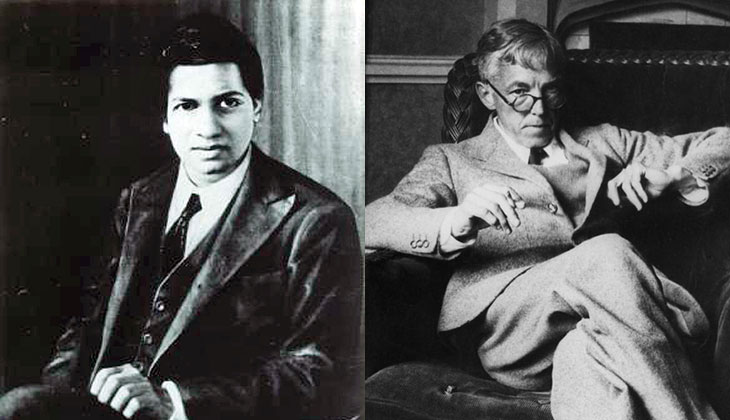
Srinivasa Ramanujan and Godfrey Harold Hardy
Ou seja,
m = O(1)
$a^3 + b^3 = c^3 + d^3$
def print_solutions(n):
    O(n²m)
def print_solutions(n):
    O(n²)
Quiz!
https://b.socrative.com/student
CODINT261
Question 1
What's the time complexity of the following code?
def foo(numbers: list[int]) -> None:
    sum_total = 0
    prod_total = 1
    for number in numbers:
        sum_total += number
    for number in numbers:
        prod_total *= number
    print(sum_total, prod_total)
| a) $O(1)$ | b) $O(\log n)$ | c) $O(\sqrt{n})$ | d) $O(n)$ |
| e) $O(n\log n)$ | f) $O(n^2)$ | g) $O(2^n)$ | h) $O(n!)$ |
| a) $O(1)$ | b) $O(\log n)$ | c) $O(\sqrt{n})$ | d) $O(n)$ |
| e) $O(n\log n)$ | f) $O(n^2)$ | g) $O(2^n)$ | h) $O(n!)$ |
Question 2
What's the time complexity of the following code?
def print_pairs(elements: list) -> None:
    for i in range(len(elements)):
        for j in range(len(elements)):
            print(elements[i], elements[j])
| a) $O(1)$ | b) $O(\log n)$ | c) $O(\sqrt{n})$ | d) $O(n)$ |
| e) $O(n\log n)$ | f) $O(n^2)$ | g) $O(2^n)$ | h) $O(n!)$ |
| a) $O(1)$ | b) $O(\log n)$ | c) $O(\sqrt{n})$ | d) $O(n)$ |
| e) $O(n\log n)$ | f) $O(n^2)$ | g) $O(2^n)$ | h) $O(n!)$ |
Question 3
What's the time complexity of the following code?
def print_pairs(elements: list) -> None:
    for i in range(len(elements)):
        for j in range(i+1, len(elements)):
            print(elements[i], elements[j])
| a) $O(1)$ | b) $O(\log n)$ | c) $O(\sqrt{n})$ | d) $O(n)$ |
| e) $O(n\log n)$ | f) $O(n^2)$ | g) $O(2^n)$ | h) $O(n!)$ |
| a) $O(1)$ | b) $O(\log n)$ | c) $O(\sqrt{n})$ | d) $O(n)$ |
| e) $O(n\log n)$ | f) $O(n^2)$ | g) $O(2^n)$ | h) $O(n!)$ |
Question 4
What's the time complexity of the following code?
def print_pairs(list_a: list, list_b: list) -> None:
    for i in range(len(list_a)):
        for j in range(len(list_b)):
            if list_a[i] < list_b[j]:
                print(list_a[i], list_b[j])
Question 5
What's the time complexity of the following code?
def print_pairs(elements: list) -> None:
    for i in range(len(elements)):
        for j in range(len(elements)):
            for k in range(100000):
                print(elements[i], elements[j])
| a) $O(1)$ | b) $O(\log n)$ | c) $O(\sqrt{n})$ | d) $O(n)$ |
| e) $O(n\log n)$ | f) $O(n^2)$ | g) $O(2^n)$ | h) $O(n!)$ |
| a) $O(1)$ | b) $O(\log n)$ | c) $O(\sqrt{n})$ | d) $O(n)$ |
| e) $O(n\log n)$ | f) $O(n^2)$ | g) $O(2^n)$ | h) $O(n!)$ |
The innermost for loop is $O(1)$
Question 6
What's the time complexity of the following code?
def revert(lst: list) -> None:
    for i in range(len(lst) // 2):
        other = lst[len(lst) - i - 1]
        lst[i], lst[other] = lst[other], lst[i]
| a) $O(1)$ | b) $O(\log n)$ | c) $O(\sqrt{n})$ | d) $O(n)$ |
| e) $O(n\log n)$ | f) $O(n^2)$ | g) $O(2^n)$ | h) $O(n!)$ |
| a) $O(1)$ | b) $O(\log n)$ | c) $O(\sqrt{n})$ | d) $O(n)$ |
| e) $O(n\log n)$ | f) $O(n^2)$ | g) $O(2^n)$ | h) $O(n!)$ |
$O(kn) = O(n)$ for any constant $k$
Question 7
Which of the following are equal to $O(n)$?
| a) $O(n + p)$, $p < \frac{n}{2}$ | b) $O(2n)$ |
| c) $O(n + \log n)$ | d) $O(n + m)$ |
| a) $O(n + p)$, $p < \frac{n}{2}$ | b) $O(2n)$ |
| c) $O(n + \log n)$ | d) $O(n + m)$ |
Question 8
Supose you have a function that receives an array of strings. Initially, we sort each string, and then we sort the array. What is the time complexity of your function?
- Sort one string: $O(s \log s)$
- Sort all strings: $O(a \cdot s \log s)$
- Sort the array: $O(a \cdot s \log a)$
- Total: $O(a \cdot s (\log a + \log s))$
Question 9
What's the time complexity of the following code?
def sum_r(root: TreeNode) -> int:
    if root is None:
        return 0
    return sum_r(root.left) + root.val + sum_r(root.right)
| a) $O(1)$ | b) $O(\log n)$ | c) $O(\sqrt{n})$ | d) $O(n)$ |
| e) $O(n\log n)$ | f) $O(n^2)$ | g) $O(2^n)$ | h) $O(n!)$ |
| a) $O(1)$ | b) $O(\log n)$ | c) $O(\sqrt{n})$ | d) $O(n)$ |
| e) $O(n\log n)$ | f) $O(n^2)$ | g) $O(2^n)$ | h) $O(n!)$ |
Binary tree does not necessarily imply logarithmic time!
Question 10
What's the time complexity of the following code?
def is_prime(n: int) -> bool:
    x = 2
    while x * x <= n:
        if n % x == 0:
            return False
        x += 1
    return True
| a) $O(1)$ | b) $O(\log n)$ | c) $O(\sqrt{n})$ | d) $O(n)$ |
| e) $O(n\log n)$ | f) $O(n^2)$ | g) $O(2^n)$ | h) $O(n!)$ |
| a) $O(1)$ | b) $O(\log n)$ | c) $O(\sqrt{n})$ | d) $O(n)$ |
| e) $O(n\log n)$ | f) $O(n^2)$ | g) $O(2^n)$ | h) $O(n!)$ |
The condition is equal to $x \leq \sqrt{n}$
Question 11
What's the time complexity of the following code?
def factorial(n: int) -> int:
    if n < 0:
        return -1
    if n == 0:
        return 1
    return n * factorial(n-1)
| a) $O(1)$ | b) $O(\log n)$ | c) $O(\sqrt{n})$ | d) $O(n)$ |
| e) $O(n\log n)$ | f) $O(n^2)$ | g) $O(2^n)$ | h) $O(n!)$ |
| a) $O(1)$ | b) $O(\log n)$ | c) $O(\sqrt{n})$ | d) $O(n)$ |
| e) $O(n\log n)$ | f) $O(n^2)$ | g) $O(2^n)$ | h) $O(n!)$ |
Question 12
What's the time complexity of the following code?
def fibo(n: int) -> int:
    if n <= 0:
        return 0
    if n == 1:
        return 1
    return fibo(n-1) + fibo(n-2)
| a) $O(1)$ | b) $O(\log n)$ | c) $O(\sqrt{n})$ | d) $O(n)$ |
| e) $O(n\log n)$ | f) $O(n^2)$ | g) $O(2^n)$ | h) $O(n!)$ |
| a) $O(1)$ | b) $O(\log n)$ | c) $O(\sqrt{n})$ | d) $O(n)$ |
| e) $O(n\log n)$ | f) $O(n^2)$ | g) $O(2^n)$ | h) $O(n!)$ |
Recursion: each function call makes other 2 calls
Question 13
What's the time complexity of the following code?
def all_fibo(n: int) -> None:
    for i in range(n):
        print(i, fibo(i))

def fibo(n: int) -> int:
    if n <= 0:
        return 0
    if n == 1:
        return 1
    return fibo(n-1) + fibo(n-2)
| a) $O(1)$ | b) $O(\log n)$ | c) $O(\sqrt{n})$ | d) $O(n)$ |
| e) $O(n\log n)$ | f) $O(2^n)$ | g) $O(n!)$ | h) $O(n 2^n)$ |
| a) $O(1)$ | b) $O(\log n)$ | c) $O(\sqrt{n})$ | d) $O(n)$ |
| e) $O(n\log n)$ | f) $O(2^n)$ | g) $O(n!)$ | h) $O(n 2^n)$ |
Question 14
def all_fibo(n: int) -> None:
    memo = [0 for i in range(n)]
    for i in range(n):
        print(i, fibo(i, memo))

def fibo(n: int, memo: list[int]) -> int:
    if n <= 1:
        return 0 if n < 1 else 1
    if memo[n] > 0:
        return memo[n]
    memo[n] = fibo(n-1, memo) + fibo(n-2, memo)
    return memo[n]
| a) $O(1)$ | b) $O(\log n)$ | c) $O(\sqrt{n})$ | d) $O(n)$ |
| e) $O(n\log n)$ | f) $O(2^n)$ | g) $O(n!)$ | h) $O(n 2^n)$ |
| a) $O(1)$ | b) $O(\log n)$ | c) $O(\sqrt{n})$ | d) $O(n)$ |
| e) $O(n\log n)$ | f) $O(2^n)$ | g) $O(n!)$ | h) $O(n 2^n)$ |
Question 15
What is the difference?
|
|
Question 16
What is the difference?
|
|
Question 17
def greatest_odd(numbers: list[int]) -> int:
    numbers.sort(reverse=True)
    for n in numbers:
        if n % 2 == 1:
            return n
    return None
| a) $O(1)$ | b) $O(\log n)$ | c) $O(\sqrt{n})$ | d) $O(n)$ |
| e) $O(n\log n)$ | f) $O(2^n)$ | g) $O(n!)$ | h) $O(n 2^n)$ |
| a) $O(1)$ | b) $O(\log n)$ | c) $O(\sqrt{n})$ | d) $O(n)$ |
| e) $O(n\log n)$ | f) $O(2^n)$ | g) $O(n!)$ | h) $O(n 2^n)$ |
Sort is $O(n\log n)$
Data Structure Average Complexities
| Name | Access | Search | Insert | Delete |
|---|---|---|---|---|
| Array | $O(1)$ | $(n)$ | $(n)$ | $(n)$ |
| Linked List | $O(n)$ | $(n)$ | $(1)$ | $(1)$ |
| Hash table | $O(1)$ | $(1)$ | $(1)$ | $(1)$ |
| Binary tree | $O(\log n)$ | $(\log n)$ | $(\log n)$ | $(\log n)$ |
Sorting in general: $O(n\log n)$
"Hashtables: Arguably the single most important data structure known to mankind. You absolutely should know how they work. Be able to implement one using only arrays in your favorite language, in about the space of one interview."